
Lenexa Previous Resident Sources
The strongest backward trail pairs ownership records with household sources. Coverage overlaps but is not seamless. Start with the newest reliable record and work toward the period of interest.
| Source | Years It Covers | Where Held | What It Shows |
|---|---|---|---|
| Register of Deeds index | 1920 to present stated | County portal and terminal | Recorded transfers, parties, legal description |
| Johnson County tax rolls | 1862 to 2007 | County Archives | Tax owner and parcel-era bridge |
| Polk county directories | 1961 to 1984 catalog run | Library and FamilySearch | Name and address snapshots; verify Lenexa volume coverage |
| Polk cross-reference | 1996 and 2000 catalog records | FamilySearch | Address-to-name route with access limits |
| Federal census | 1900 to 1950 released | NARA and library databases | Household at the census date |
| Lenexa permits | 2019 to 2023 mapped examples | Community Development | Construction and project dates, not full ownership |
For a recent transfer, start with the county parcel card and deed index. For the paper era, ask Archives about the indexed tax roll and use the library for directories, newspapers, maps, and census access. No official source promised a complete Lenexa house history as one service.
Fix the Lenexa Parcel First
Enter the current situs in the Johnson County tax search or AIMS/JCLR. Record the Quick Reference ID, Tax Property ID, KUPN, legal description, subdivision, lot and block, current owner, mailing address, and map number. Save a dated copy because ownership and tax values change.
The mailing address is where tax correspondence goes. It may be outside Lenexa and does not prove where the owner lives. The legal description and parcel IDs are far more durable than a person’s name or a street line. This small step prevents the deed chain from drifting to a nearby lot or a same-name owner.
Trace Johnson County Deeds Backward
The Register of Deeds document library supplies the recorded ownership spine. It states index coverage from 1920 to the present, with legacy documents from 1920 through 1987 and plats from 1866 forward. The street address is only a starting clue because the index works through party names and legal descriptions.
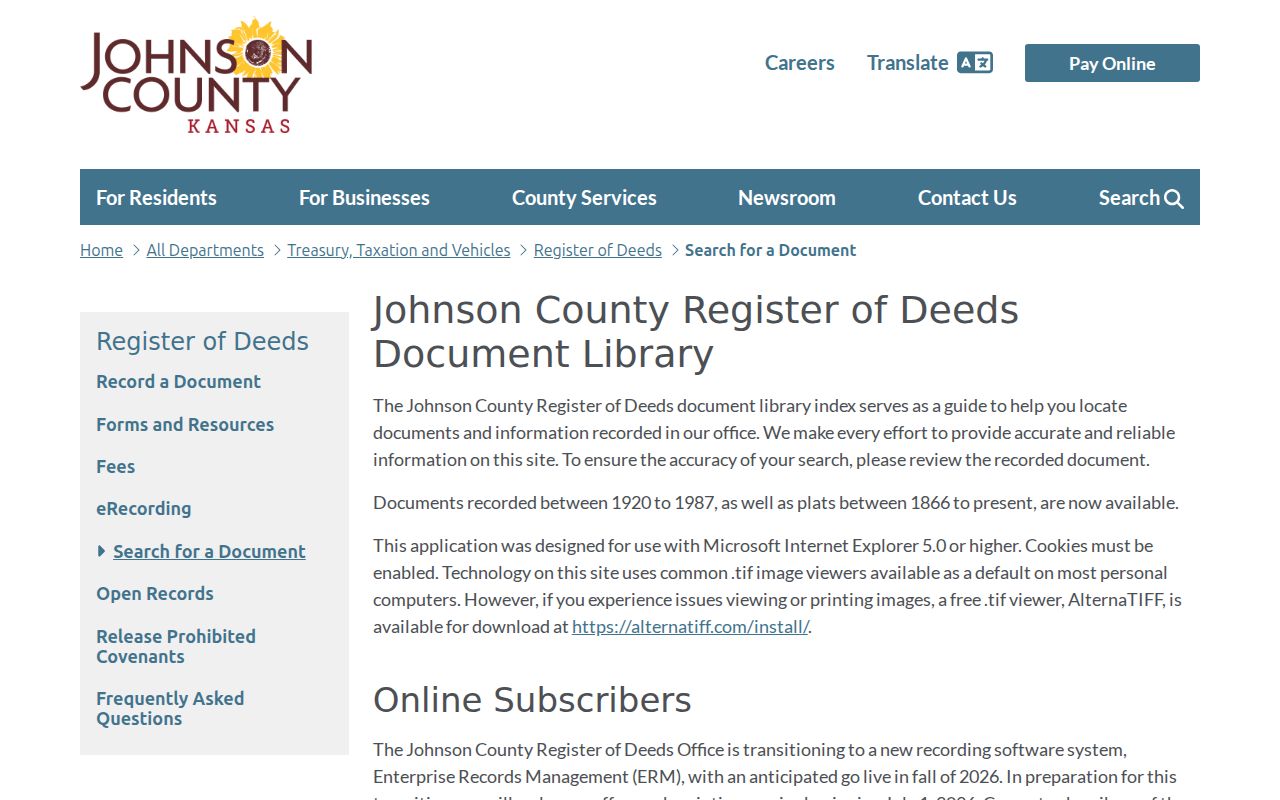
The library screen marks the online route. Older or missing documents require the office terminal, an email or mail request, or help from a title professional.
- Find the present tax owner and copy the parcel’s full legal description.
- Search that owner as grantee and open the purchase deed.
- Record the grantor, date, instrument or book/page number, and matching land description.
- Search that grantor as an earlier grantee, using the same parcel clues.
- Repeat until the index ends, then move to the public terminal, requested copies, or tax rolls.
- Grantor
- The person or entity transferring a recorded interest.
- Grantee
- The person or entity receiving that interest.
- Chain of title
- The ordered series of recorded transfers for the same land.
- Legal description
- The lot, block, subdivision, or metes-and-bounds wording that identifies land apart from its mailing line.
Lenexa Deed Research Fallbacks
The Register of Deeds research guidance directs researchers to the public computer at 111 S. Cherry Street, Suite 1200, in Olathe. Office search hours are Monday through Friday, 8 a.m. to 5 p.m., and the office asks researchers to email for a computer appointment. Copies cost $0.25 per page and certification costs $13.
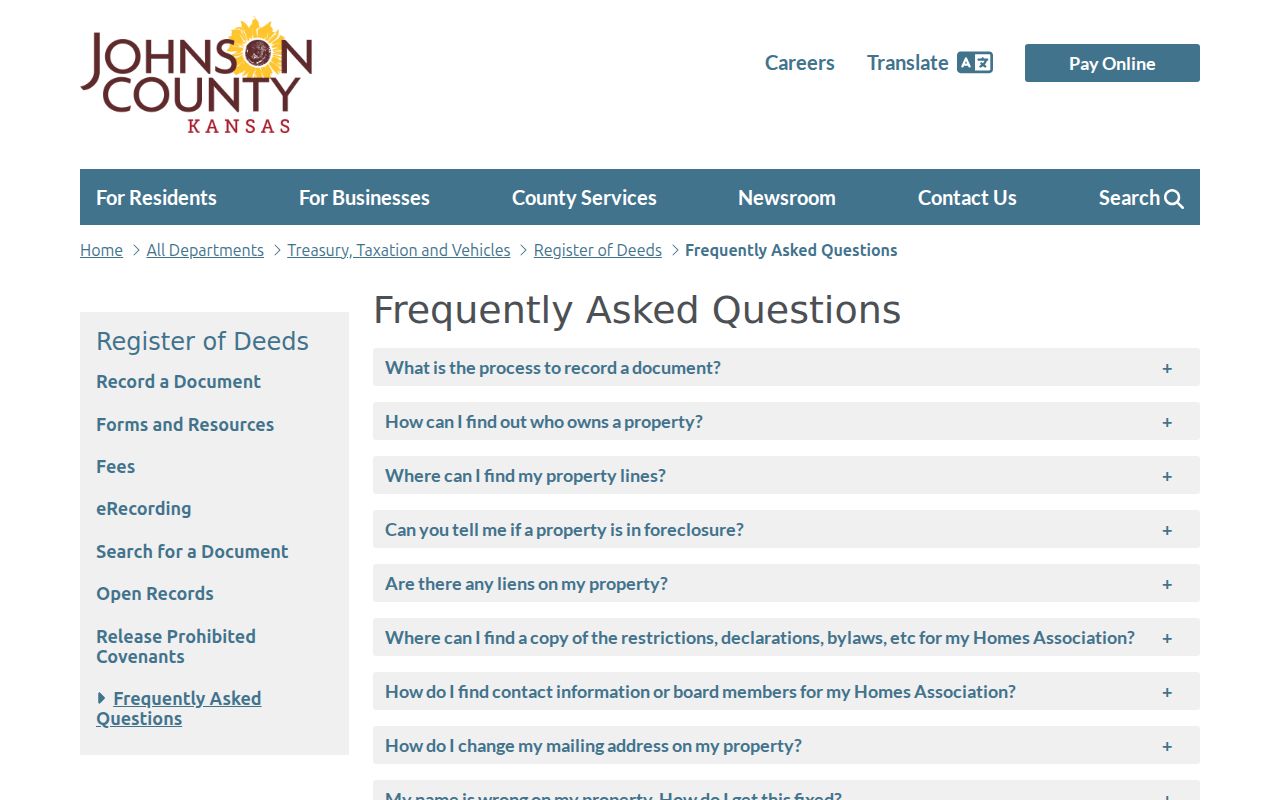
The guidance makes the terminal and request route essential when a previous-resident trail falls outside the web index.
The county’s recording fee schedule distinguishes research copies from recording and certification charges.
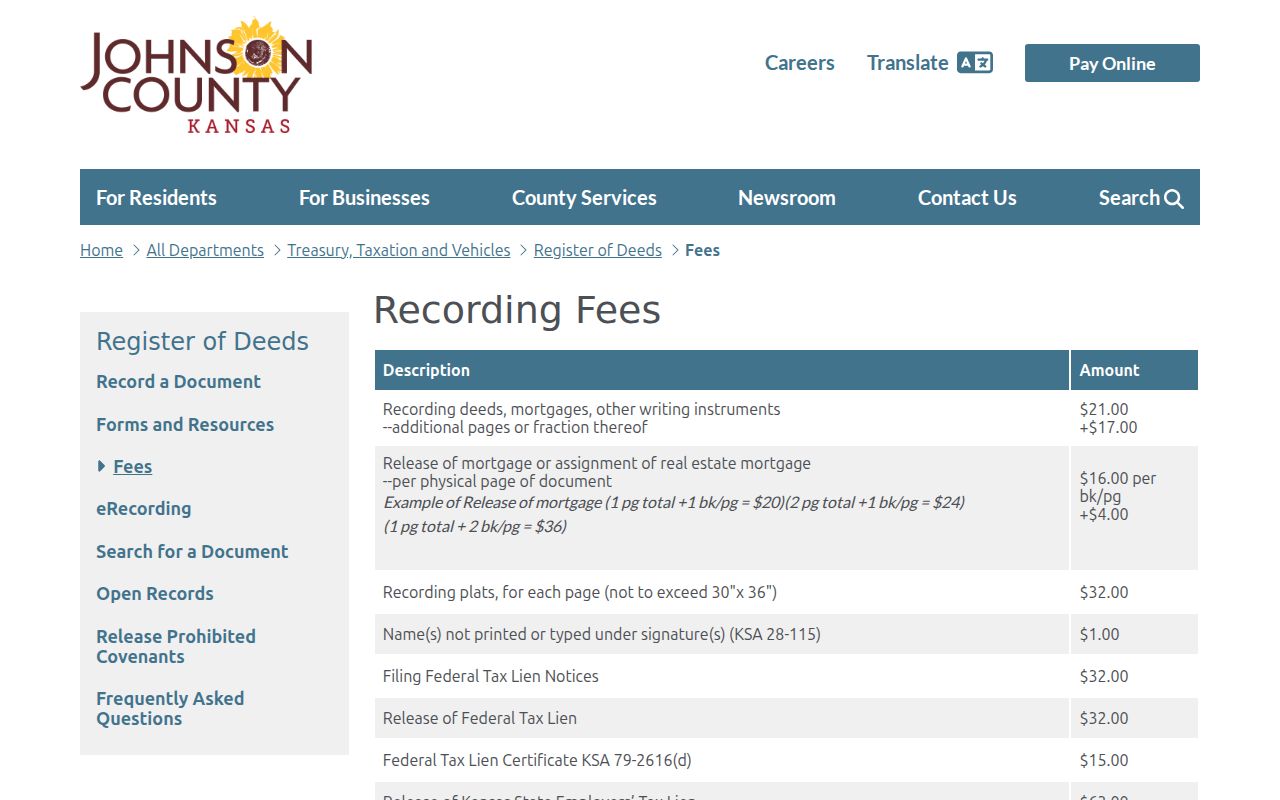
Check the current schedule before ordering. A plain copy can support research, while a certified copy is the formal office-issued version.
Lenexa Tax Rolls Reach 1862
Johnson County Archives and Records Management holds indexed tax rolls from 1862 through 2007. They can bridge an era before the advertised online deed index, but a tax name remains ownership or tax evidence, not proof that the person lived on the land.
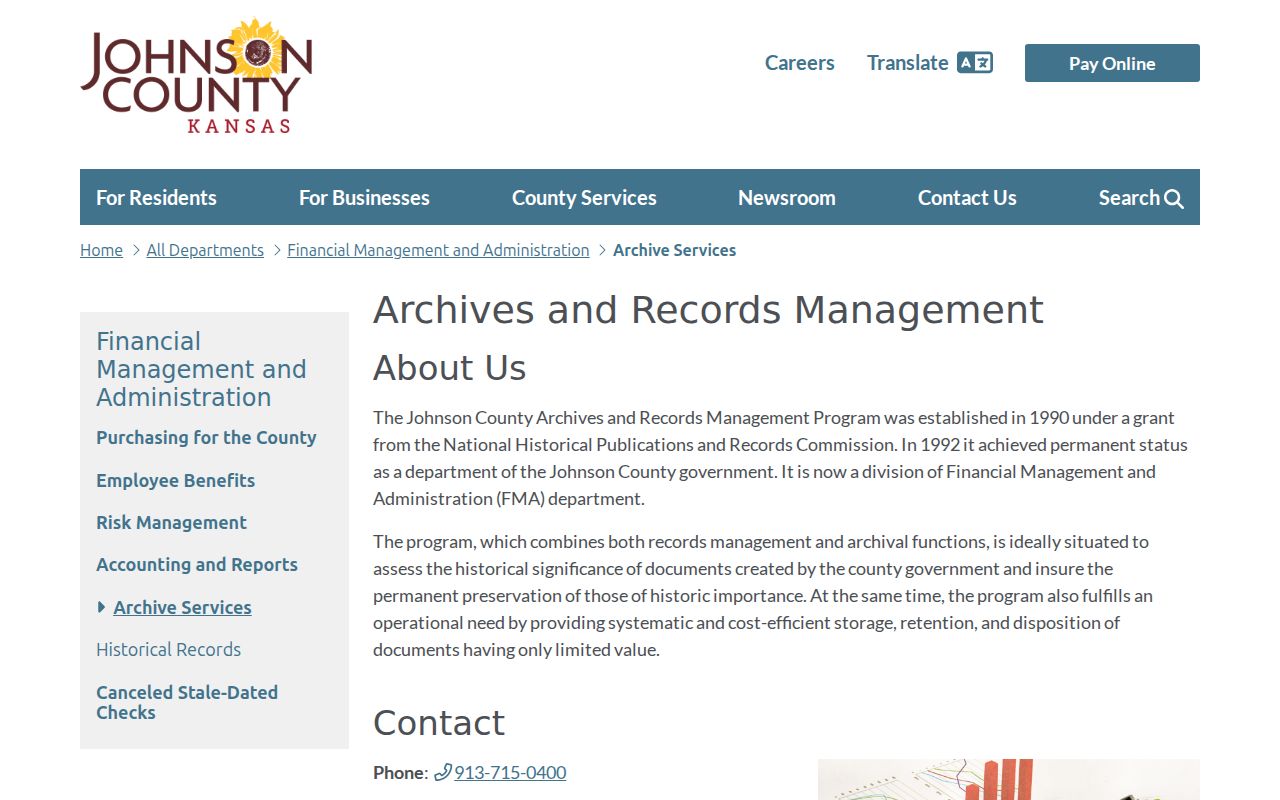
The Archives research room works by appointment and also accepts phone, mail, and email reference requests.
Archives staff will search indexed records and books for up to 30 minutes per request. More research costs $25 per hour, arranged in advance. Staff do not conduct broad genealogy, surname-wide searches, census work, transcription, or interpretation. Give a person, record group, date span, and parcel or index clue.
Johnson County Historical Record Routes
The county’s historical records inventory points beyond tax rolls to probate journals, wills, settlements, naturalization, divorce, and historical court material. These records can explain a transfer by estate, changed surname, or heir.
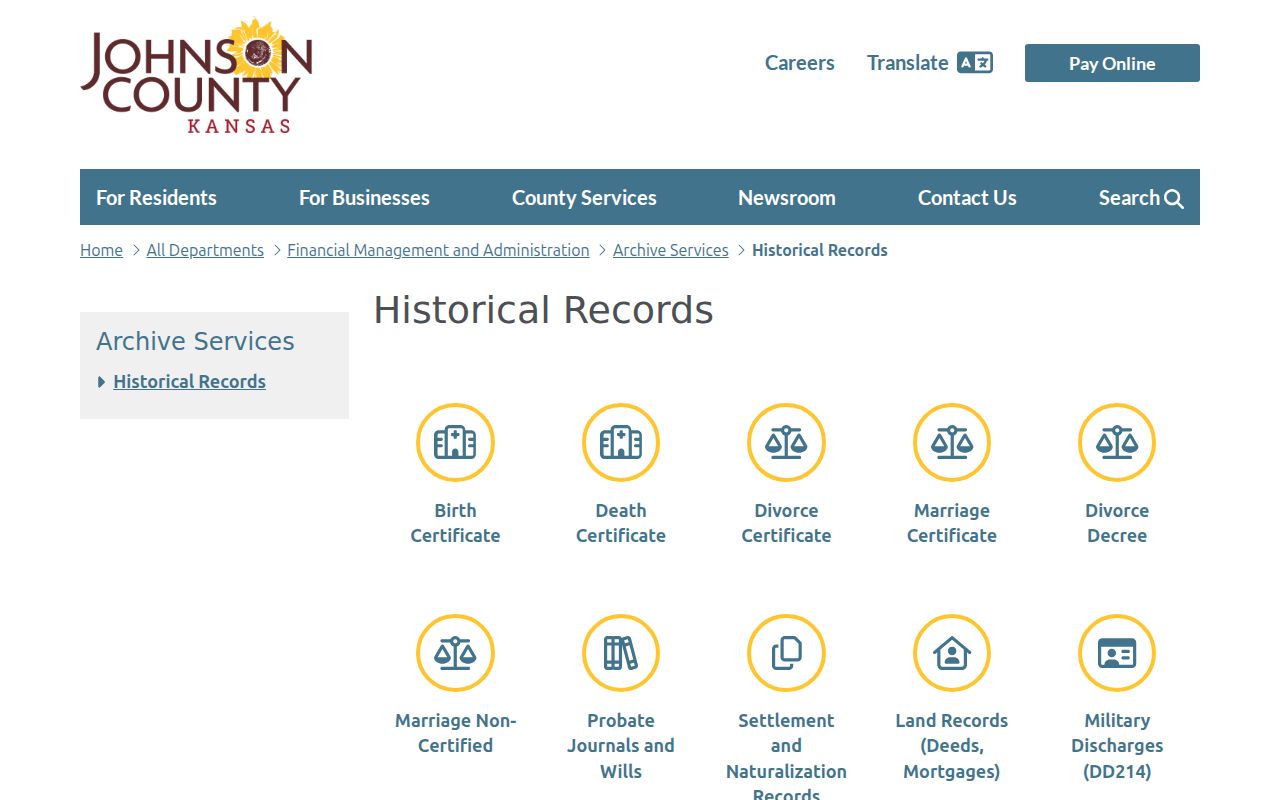
The inventory helps route a narrow request to Archives or District Court instead of asking one office for every fact about a former household.
Pair Lenexa Directories and Census
Deeds establish recorded interests, not all occupants. For each owner span, check a directory year before and after the transfer, then compare a released federal census. The catalog evidence includes Polk’s Olathe and Johnson County run from 1961 through 1984, cross-reference records for 1996 and 2000, and Mission volumes from 1962 through 1964. Confirm Lenexa coverage in the exact volume.
- Choose the deed-transfer year and list the street line exactly as recorded.
- Check the closest directory on each side of that date for a listed name or business.
- Preserve spelling, initials, and the printed postal place without silently modernizing it.
- Compare a released 1900 through 1950 census schedule when the era fits.
- Use age, family relationship, birthplace, and occupation only as that census reported them on its reference date.
Later census schedules follow the 72-year release rule. Boundary and enumeration problems can also shift a household away from a modern address search. The collections themselves belong on the Lenexa city directory page.
Lenexa Postal Names Can Shift
USPS changed the preferred last line to Lenexa for ZIP Codes 66220, 66227, and 66285 in 2001. An older directory may therefore print Shawnee Mission for a place now mailed as Lenexa. Preserve the historic line, then verify the modern address through USPS and AIMS.
No official source found a single citywide street-renumbering date. When a number or name fails, use the legal description, original 1869 plat, recorded subdivision, railroad and Old Town maps, and the AIMS Historic Right-of-Way Document Search. That right-of-way collection covers road dedications, vacations, and changes from about 1850 to 1949.
Lenexa Lives Beyond Property Files
The Kansas Historical Society’s Johnson County holdings add life to a chain of names and dates. The collection includes a Lenexa diary from 1909 through 1913, early city-election images, railroad and depot scenes, and farm and business records.
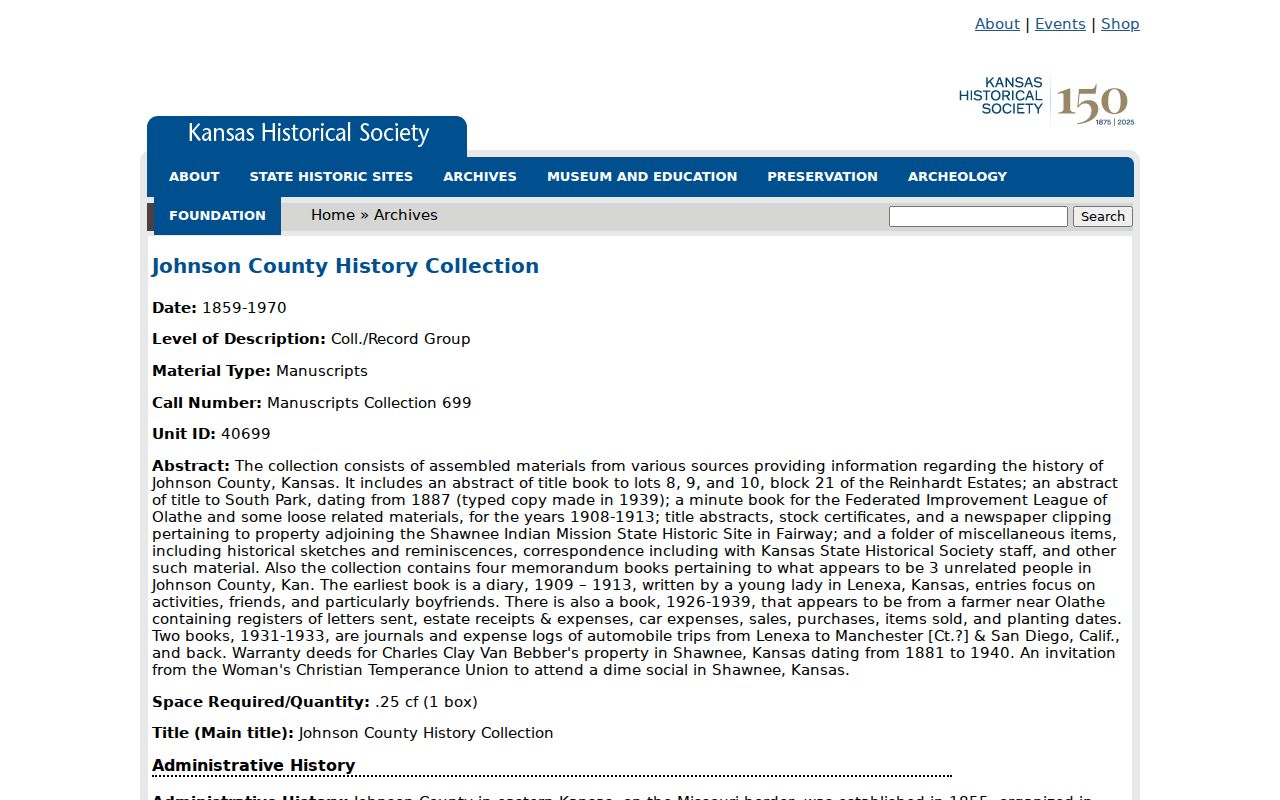
These sources can place a former household in its local setting without claiming that a photograph or diary proves residence at a particular parcel.
Lenexa Deed Portal Transition
As of August 24, 2026, Johnson County planned to launch Enterprise Records Management in fall 2026. Its old subscription service ended July 1. The replacement was expected to require a new account, allow free watermarked viewing, and charge for printing or certification.
Search screens may change while the underlying record remains with the Register of Deeds. Record the instrument number and legal description, not just a temporary portal URL. If the online chain breaks during the change, use the office terminal, email, mail, or a requested copy.
Note: Johnson County has no property-fraud alert service, so verify a suspicious deed notice directly with the recorder rather than enrolling elsewhere.
Confirm Lenexa Past Households
Previous residents become credible only when the source matches the claim. A directory names a listed occupant or business for one issue. A census counts a household on one reference date. An obituary can name relatives and places, while probate can explain an heir transfer. None alone proves continuous residence between dates.
Johnson County Library holds late nineteenth-century to present obituary citations and a local newspaper file for 1977 through 2000. Probate journals, wills, and settlements route through Archives or District Court. The University of Kansas Lenexa Methodist collection covers members, baptisms, marriages, and deaths from 1865 through 1929, offering a useful family-history route when certified vital records are restricted.
Sanborn maps can show building footprints, material, stories, uses, lot lines, and fire features, but no Lenexa-specific edition was confirmed. Do not substitute an Olathe or Kansas City sheet. First verify the town and year in the Library of Congress, KSHS, or library catalog.
Lawful use. Trace Lenexa previous residents for house history, genealogy, estate research, or personal curiosity. Never use an old address trail to track, stalk, threaten, or harass a living person.